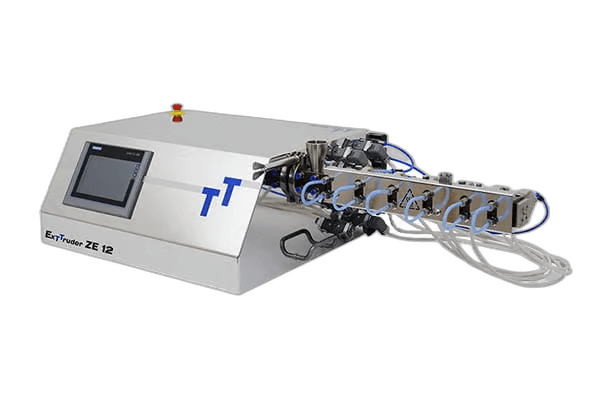
SCREENING · MICRO + MINI
Hybrid ZE 5/9
The lowest-material entry point. Run at 5 mm, then step to 9 mm when a formulation earns more material.
- Diameters
- 5 / 9 mm
- Max torque
- 2.5 / 14.5 Nm
- Volume class
- Micro + Mini
- Best for
- Pharma, new polymers
01 / 07 — TWIN-SCREW MICRO COMPOUNDERS · CONTINUOUS AND BATCH · FROM 1 GRAM
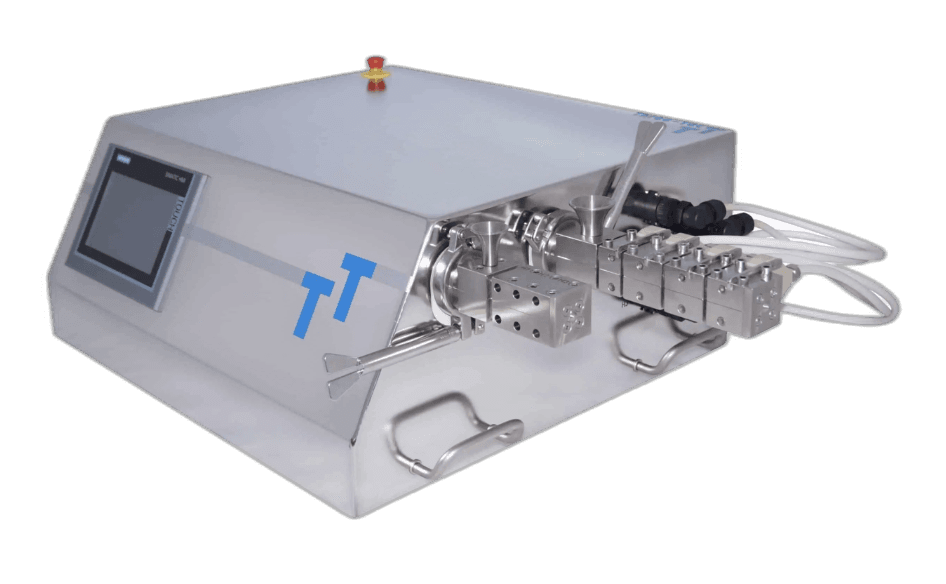
Parallel co-rotating twin-screw micro compounders built by Three-Tec GmbH—with application engineering, installation, and trials from our Piscataway, New Jersey lab. Run continuously, or add the recirculation channel for a timed batch workflow.
Ø 5 mm
2.5 Nm
Ø 9 mm
14.5 Nm
Ø 12 mm
20 Nm
1 g
Minimum starting batch at 5 mm
1.2 cm³
5 mm empty volume at L/D 15:1
0.7–0.8 g
Typical recovery from a 1 g charge
2 modes
Continuous and timed batch
02 / 07 — START WITH THE JOB
Most laboratories buy for one of three jobs. Start with the material, output, and amount available—not a model number.
03 / 07 — THE LINEUP
Three volume classes are set by screw diameter. Each Hybrid carries two of them on one table-top frame, so one instrument covers two development stages and switches between them in minutes.
MICRO · Ø 5 mm
1.2 cm³
Free volume at L/D 15:1. Charges from 1 gram for APIs, newly synthesized polymers, and costly additives.
MINI · Ø 9 mm
14.5 Nm
Mid-range formulation work with more torque for viscous melts. Free volume is confirmed during configuration.
LAB · Ø 12 mm
20 Nm
Filled and fiber-reinforced compounds, plus enough material for molding and testing. Free volume is confirmed during configuration.
| Model | Micro · 5 mm | Mini · 9 mm | Lab · 12 mm |
|---|---|---|---|
| Hybrid ZE 5/9 | ● | ● | — |
| Hybrid ZE 5/12 | ● | — | ● |
| Hybrid ZE 9/12 | — | ● | ● |
| ZE12 Compounding Line | — | — | ● |
SCREENING · MICRO + MINI
The lowest-material entry point. Run at 5 mm, then step to 9 mm when a formulation earns more material.
SCREEN-TO-SAMPLE · MICRO + LAB
The widest span on one frame: 1-gram screening plus the 12 mm torque needed for useful sample quantities.
HIGH-TORQUE · MINI + LAB
For filled and viscous systems where the lab does not need to operate below the 9 mm scale.
FIBER & FILLER PACKAGE
A long-L/D ZE12 with gravimetric feeding, optional side feeding, and pelletizing for fiber and highly filled systems.
04 / 07 — FINISH THE SAMPLE
Every compounder can be configured as a complete line around the sample your laboratory actually needs.
Strand pelletizing or hot die-face cutting for 0.5–10 mm pellets, including brittle and highly filled melts.
Slit die, film-roll calibration, and tension-controlled winding for cast-film screening.
Mono- and multifilament spinning, cooling bath, and winding—including 3D-printing filament.
Prepare compounded material for downstream molding and standardized mechanical testing.
05 / 07 — HOW IT DIFFERS
Add the recirculation channel for the timed batch workflow laboratories already know. Open it and the same machine runs continuously with the screw geometry and feeding approach that transfer to larger production extrusion.
| Question | Xceptional / Three-Tec | Typical batch-only unit |
|---|---|---|
| Batch mode, set mixing time | Yes—with the optional recirculation channel | Yes |
| Continuous mode | Yes—parallel co-rotating screws | No |
| Screw configuration | Modular elements arranged for the formulation | Typically a fixed screw profile |
| Scale-up path | Same element concept from 5 mm to production sizes | Transfer to a different machine type |
| Feeding | Gravimetric micro-feeding and optional side feeding | Manual charge |
| Two screw sizes, one frame | Yes—Hybrid configurations | No |
06 / 07 — APPLICATIONS & PROOF
Chopped glass and carbon fiber, minerals, and flame retardants at high loading.
Disperse expensive additives in gram quantities before committing kilograms of material.
Evaluate heat-sensitive materials with short residence times and independent thermal zones.
Continuous mixing of active material, binder, and conductive additive for dry and wet research.
Develop highly filled injection-molding feedstocks with controlled feeding and mixing.
Screen amorphous dispersions and implant formulations from limited API quantities.
07 / 07 — TRY IT ON YOUR MATERIAL
Our Piscataway laboratory can begin with limited material. Attend onsite, join by video, or let our team run the agreed plan and send the results.
Micro compounder FAQ
A bench-top twin-screw machine that melt-mixes polymers with additives, fillers, or active ingredients in small quantities for formulation development. This platform can operate continuously or in timed batch recirculation mode.
The 5 mm configuration can begin from 1 gram. Practical material requirements depend on density, feeding behavior, stabilization, recovery, and the sample quantity needed for testing.
Yes. With the optional recirculation channel, the melt circulates for a mixing time you set and then discharges. With the channel open, the same machine runs continuously.
Yes. Each Hybrid configuration carries two diameters—5/9, 5/12, or 9/12 mm—on one table-top frame with shared controls and supporting components.
Yes. A 12 mm configuration can be equipped with side feeding for chopped fiber and filler. A material trial is recommended to confirm loading, feed behavior, dispersion, and fiber-length goals.
Xceptional Instruments provides application engineering, trials, installation, training, and service from Piscataway, New Jersey. Three-Tec GmbH builds the equipment in Seon, Switzerland.