Case study · December 7, 2024
Special production: Production line for the manufacture of ceramic injection molded feedstocks
Challenge
Produce homogeneous ceramic injection-molding feedstock in one-to-ten-kilogram research batches with stronger mixing than the available laboratory setup.
Approach
Evaluate an 18 mm twin-screw line with separate powder and binder feeding, controlled cooling, and pelletizing before configuring the production system.
Result
The trials demonstrated a continuous, single-stage route with effective melting, dispersion, and simpler downstream handling.
Most of our equipment is developed and produced specifically to customer requirements. This was also the case with a production line for the manufacture of ceramic injection molded feedstocks, which was recently delivered. Although the customer initially wanted to procure a shear roll, trials in our laboratory convinced him of the suitability of our twin-screw extruders for his requirements.
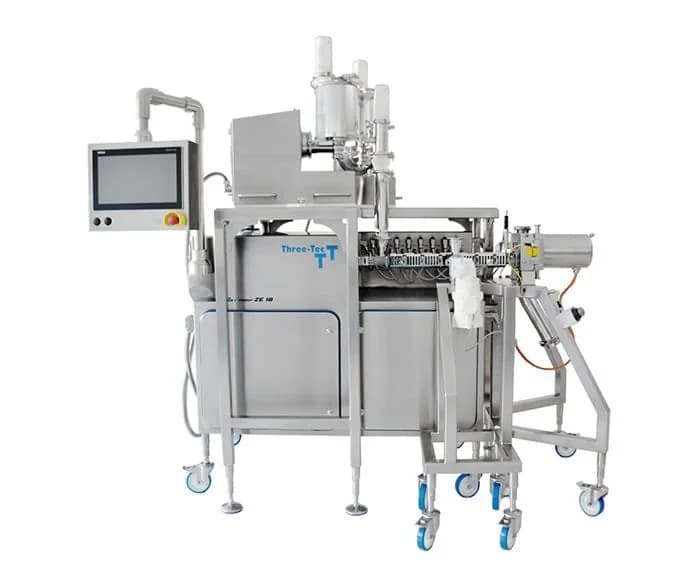
Extruder: ZE 18 HMI · Metering device: ZD 12 twin screw feeder with flat-tray, ED 20 single screw feeder · Process Equipment: Cooling conveyor belt, granulator · Batch weight: 1 to 10 kg · Application: Research & Development
The initial contact with the customer came through a recommendation from an existing client. The customer was seeking a shear roll system for producing ceramic injection molding (CIM) feedstocks at a laboratory scale. The equipment was intended to produce batches ranging from one to ten kilograms from a mixing unit.
Because shear-roll and extrusion technologies address related mixing goals, the equipment manufacturer proposed trials on an existing twin-screw extruder to evaluate whether extrusion could meet the application as an alternative. The customer already had a laboratory extruder from another supplier, but its available torque and mixing effect were not sufficient for the feedstock, which had led the team to consider a shear roll.
The trials used a ZE 18 extruder with an 18 mm screw diameter and an L/D 40 process length (720 mm) to evaluate compounding and homogenization. A powder feeder handled a premix of three solid components, a pellet feeder handled two binder components, and a conveyor and pelletizer provided controlled cooling and granulation. After processing, cleaning granules reduced the manual cleanout work, and the customer collected the extruded and granulated material for further analysis.
The successful tests, which exceeded the customer's expectations, led to the order of the complete set of equipment with which the tests were carried out.
The main reasons for the decision in favor of the extruder were:
Extrusion as a continuous process incl. automated feeding of raw materials.
Very good melting, homogenizing, dispersing properties.
A lower throughput time and a single-stage instead of a multi-stage process, compared to the existing laboratory extruder.
The resulting highly efficient production of ceramic injection molded feedstocks and significant simplification of work in the laboratory.
The manufacturing team developed and produced the plant against the customer-specific requirements, then commissioned the configured line at the customer site.
01 / 01 — MORE CASE STUDIES